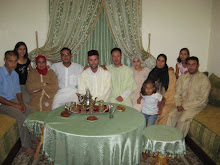
After experiencing Leid Kbir, I would have to say that I have now encountered what I believe to be the most extreme cross cultural integration event that I may experience during my entire stint here in Morocco. To elaborate on this Muslim holiday from my last entry, it is actually kind of like Christmas. Just instead of a pine tree, every family gets a sheep...and instead of setting it up in their living room and decorating it, they take it to their back yard and slaughter it. And instead of receiving presents, family members gather around to receive their portions of mystery meat.
What I mean by the Christmas comparison is that the feeling of loving thy family, getting together and celebrating is very much the same. The medium to get there is just a bit different. Its actually kind of admirable...every participating family seems to know exactly what their doing while slaughtering and preparing the animal. I don't know of one member in my entire family, extended included, who would have the slightest clue as to what to do with a sheep, dead or alive. I was asked if for Thanksgiving we gather around and watch as the turkey is slaughtered...and I felt stab of laziness as I replied that, well, no, most families I know of, including my own, buy a pre-killed, pre-skinned turkey. Perhaps after another year of watching some good ol fashioned slaughterins I'll be able to step up to the plate, butcher knife in one hand, live turkey head in the other.
I was also lucky enough to be in a large family, which required both a cow and a sheep to feed sufficiently. The first slaughtering came about a bit unexpectedly...2 days before the official beginning of Lied. I was on my way out the door for my tutoring session, and was told that I had to cut the session an hour short in order to catch the show. This was communicated to me by my host sister saying I had to be back for the (drags her finger across her neck with a big smile across her face). And boy am I glad I made it back in time. The whole family was there, many of whom had just arrived that day to make the occasion. My mom made tea and cookies, and we watched family butchers go to work as if we were watching the superbowl. I couldn't resist posting the pictures of this that I was encouraged to take, so I apologize to those of you with weak stomachs. Anyways, whats there not to love? It's the circle of life, and we are at the top of the food chain! Hoorah!
As for the food, its actually been delicious thus far. For the past 3 days I have eaten nothing but meat kabobs, mixed with tasty spices and bread. However, I may be speaking preemptivley since I have yet to eat any liver, eyes, or testicles. There is plenty of sheep left, and we are just now getting to the last of the cow, so for those of you who are reading this on the edge of your seats, I shall keep you posted. Happy Holidays!
Wednesday, December 26, 2007

Thursday, December 13, 2007
So I have now been on Tinjdad for about 3 weeks. An interesting thing has happened to my perception of time since being here thus far. While in PST time seemed to slow down substantially, time has now seemed to have sped up, and the past 3 weeks have really flown by. Perhaps because I am now much more relaxed and on my own schedule. Interesting how time changes. Anyway, I have had a great first 3 weeks here, and would say the integration process is going quite smoothly. I am now teaching English on a regular basis and am loving it. My students are great...most of them at least have an English foundation from which I can build upon easily. For example, my "beginner" class speaks better English than I speak Moroccan Arabic. This is much easier and fun (and better for a teachers mental stability) than spending hours going over the alphabet and numbers until you sound like Rainman. I also have activities every Saturday, which thus far have been girls basketball. In order for girls to have a chance to play any sport here without any male interference there must be some kind of facilitator to regulate. That’s where I come in. Hopefully I can couch better than I play, and we can win some games in our region. The Tinjdad girls have played a neighboring town, Golmima, several times in the past few months have lost by a long shot every time. If anyone reading this has any plays they’d like to pass my way that would be awesome.
I have met a good amount of useful people in the area, including 4 English teachers who have been extremely helpful in getting me situated. I am now getting tutored by two teachers, which I think is good since it allows me to practice with people different accents. Once I get into the swing of things a bit more, I will begin teaching English in the Neddy Neswi, which is like a Dar Chebeb for women. I also plan on doing some work with theatre and music. My students are very interested in all aspects of American culture, one of them being music, yet have never heard Jimi Hendrix so it seems like we have a lot to cover. On the note of cultural exchange, I have begun a pen pal exchange program with the students in my Dar Chebab and my cousin Ali's class of 8th graders in the states. I am really excited about this...it seems like a great way for the students in both countries to learn about each others cultures, without us teachers having to do all that much.
Last week my host brother took me to the museum of Tinjdad, which is incredible. The main thing that’s incredible about it is, well, its a museum in my Peace Corps site! Here I was crossing my fingers on running water and electricity, and I get all that and a museum on top of it. Sweet. It gives a detailed account of the history of Tinjdad and the surrounding region. It has tons of artifacts, some of which date back nearly a thousand years. It also has lots of artwork from my host brother Rachid, who, as I mentioned in a previous entry, is a well recognized artist in the area. To top it all off it has narratives in English! It is probably the only thing in English in the entire town. It is attached to a hotel, which has got to be one of the coolest hotels I have ever seen. Most of the rooms are different from one another, yet each has a classy desert vibe. The prices are decent too. I highly recommend it to anyone passing through.
So what else...Leid Kbir is right around the corner. For those of you who don't know (which is probably most of you reading this), Leid Kbir is the Muslim holiday in which every family slaughters 1 or more sheep and proceeds to eat every last part of its body throughout the course of a few weeks. This includes everything from the eyes, to the testicles, to the skin on the face. The slaughtering conveniently lands about a week before Christmas, so when my family is back at home eating their Christmas ham, I will be here eating my Leid Kbir sheep testicles. Tis the Season! I shall definitely has further updates on that as it occurs.
That’s all I got for now. Until next time...
I have met a good amount of useful people in the area, including 4 English teachers who have been extremely helpful in getting me situated. I am now getting tutored by two teachers, which I think is good since it allows me to practice with people different accents. Once I get into the swing of things a bit more, I will begin teaching English in the Neddy Neswi, which is like a Dar Chebeb for women. I also plan on doing some work with theatre and music. My students are very interested in all aspects of American culture, one of them being music, yet have never heard Jimi Hendrix so it seems like we have a lot to cover. On the note of cultural exchange, I have begun a pen pal exchange program with the students in my Dar Chebab and my cousin Ali's class of 8th graders in the states. I am really excited about this...it seems like a great way for the students in both countries to learn about each others cultures, without us teachers having to do all that much.
Last week my host brother took me to the museum of Tinjdad, which is incredible. The main thing that’s incredible about it is, well, its a museum in my Peace Corps site! Here I was crossing my fingers on running water and electricity, and I get all that and a museum on top of it. Sweet. It gives a detailed account of the history of Tinjdad and the surrounding region. It has tons of artifacts, some of which date back nearly a thousand years. It also has lots of artwork from my host brother Rachid, who, as I mentioned in a previous entry, is a well recognized artist in the area. To top it all off it has narratives in English! It is probably the only thing in English in the entire town. It is attached to a hotel, which has got to be one of the coolest hotels I have ever seen. Most of the rooms are different from one another, yet each has a classy desert vibe. The prices are decent too. I highly recommend it to anyone passing through.
So what else...Leid Kbir is right around the corner. For those of you who don't know (which is probably most of you reading this), Leid Kbir is the Muslim holiday in which every family slaughters 1 or more sheep and proceeds to eat every last part of its body throughout the course of a few weeks. This includes everything from the eyes, to the testicles, to the skin on the face. The slaughtering conveniently lands about a week before Christmas, so when my family is back at home eating their Christmas ham, I will be here eating my Leid Kbir sheep testicles. Tis the Season! I shall definitely has further updates on that as it occurs.
That’s all I got for now. Until next time...
Thursday, November 29, 2007
Well, it has finally arrived…the day that seemed like it never would. I have arrived to my final site for good, and shall remain here for the next 2 years. I am now an official volunteer, and should theoretically be fully prepared to live on the edge of the Sahara for the next 2 years of my life.
Apologies to those of you who have been waiting for a new update for the past few weeks and have failed to receive one until now. As usual, I have been incredibly busy, yet these past 2 weeks have been an unusual exception since it was the home stretch of pre-service training. In the past few weeks we have crammed for our final language exam, taken it, met up with the small business development group, continued technical training, had a larger thanksgiving dinner than I ever deemed possible, and gotten sworn in as official volunteers. Figuring out where to begin with a blog entry has thus become a more difficult task than it typically should be.
How about I start with Thanksgiving dinner. I'm not really sure what to say about it other than it was better than I ever thought was possible in a country in which its celebration does not exist. Fortunately, however, Morocco is a culture in which most holidays are celebrated by a huge feast of some sort, so in this case, they could certainly relate to it a lot more than something like Halloween. We had about 10 volunteers on cooking staff, who successfully managed to cook for about 80 people (67 volunteers and nearly 15 language teachers and staff members). It was impressive, to say the least.
Following thanksgiving was the tail end of training. This involved a ton of power points reviewing policies and safety procedures...not a big surprise. One of the highlights of meeting up with the SBD group was the SBD vs. YD talent show. For this I decided that it was only necessary to write an end of PC training song and perform it with a fellow volunteer musician. It worked out well...we sang it to the tune of Pink Floyd's "The Wall", and touched on many common training subjects, such as seemingly never ending power points, diarreah, and the feeling one has when initially being dropped off into the middle of nowhere for the next 2 years of one's life. Judging by the overwhelming laughter, everyone seemed to enjoy it.
Swearing in was perfect. We had it held in what must be the nicest hotel in all of Fes; on the top of a mountain overlooking the Medina, right next to some old Roman ruins. Everyone that I have interacted with since being in Morocco was in attendance...including my first host family. It was great to see them and catch up in broken Arabic...they did mention that my language had improved, which was encouraging since it is sometimes difficult for me to tell. Three of the volunteers from my stage gave speeches in Moroccan Arabic, Tamazigte, and Tashlehete...although I had trouble understanding most of it, the host country nationals(HCN's) in the audience seemed really receptive. A job well done.
I am currently in what will soon become my apartment, which I have taken over from a current volunteer. I am very happy with it, especially since I can play put-put golf on the roof(thanks to the creativity of the former volunteer), and get hot showers and internet right away. He even left me a full jar of Skippy peanut butter! His efforts will not be forgotten. This will have to be all for now, however, now that I have my own internet connection, and no longer have training to deal with, entries should be much more frequent(this time I'm serious). Until next time...
Apologies to those of you who have been waiting for a new update for the past few weeks and have failed to receive one until now. As usual, I have been incredibly busy, yet these past 2 weeks have been an unusual exception since it was the home stretch of pre-service training. In the past few weeks we have crammed for our final language exam, taken it, met up with the small business development group, continued technical training, had a larger thanksgiving dinner than I ever deemed possible, and gotten sworn in as official volunteers. Figuring out where to begin with a blog entry has thus become a more difficult task than it typically should be.
How about I start with Thanksgiving dinner. I'm not really sure what to say about it other than it was better than I ever thought was possible in a country in which its celebration does not exist. Fortunately, however, Morocco is a culture in which most holidays are celebrated by a huge feast of some sort, so in this case, they could certainly relate to it a lot more than something like Halloween. We had about 10 volunteers on cooking staff, who successfully managed to cook for about 80 people (67 volunteers and nearly 15 language teachers and staff members). It was impressive, to say the least.
Following thanksgiving was the tail end of training. This involved a ton of power points reviewing policies and safety procedures...not a big surprise. One of the highlights of meeting up with the SBD group was the SBD vs. YD talent show. For this I decided that it was only necessary to write an end of PC training song and perform it with a fellow volunteer musician. It worked out well...we sang it to the tune of Pink Floyd's "The Wall", and touched on many common training subjects, such as seemingly never ending power points, diarreah, and the feeling one has when initially being dropped off into the middle of nowhere for the next 2 years of one's life. Judging by the overwhelming laughter, everyone seemed to enjoy it.
Swearing in was perfect. We had it held in what must be the nicest hotel in all of Fes; on the top of a mountain overlooking the Medina, right next to some old Roman ruins. Everyone that I have interacted with since being in Morocco was in attendance...including my first host family. It was great to see them and catch up in broken Arabic...they did mention that my language had improved, which was encouraging since it is sometimes difficult for me to tell. Three of the volunteers from my stage gave speeches in Moroccan Arabic, Tamazigte, and Tashlehete...although I had trouble understanding most of it, the host country nationals(HCN's) in the audience seemed really receptive. A job well done.
I am currently in what will soon become my apartment, which I have taken over from a current volunteer. I am very happy with it, especially since I can play put-put golf on the roof(thanks to the creativity of the former volunteer), and get hot showers and internet right away. He even left me a full jar of Skippy peanut butter! His efforts will not be forgotten. This will have to be all for now, however, now that I have my own internet connection, and no longer have training to deal with, entries should be much more frequent(this time I'm serious). Until next time...
Monday, November 12, 2007
Tinjdad...more information
In search of more information on Tinjdad, I stumbled upon the following information, most of which I took out of the blog of a former Tinjdad PCV, Andy. After visiting Tinjdad for a week, I find everything said in its description of the present to be very accurate. Enjoy!
Tinjdad, Morocco
The town of Tinjdad, Morocco is located in Eastern Morocco on the main road from Ouarzazate to Errachidia/Erfoud about forty kilometers past Tinghir. Most of its population consists of Berbers from the Ait Merad tribe, and despite the French and Arab conquests of the Berbers of Morocco, its original culture and language are largely intact as you can quickly observe in their daily activities, primary spoken language, and traditions.
Its History
Originally, Tinjdad consisted of a small desert oasis called Ferkla. Its first inhabitants were nomads, called injda in their native tongue, traveling from the nearby High Atlas Mountains and the Jbel Sarhro mountains. As time passed, more and more of injda built ksars within the Ferkla oasis, making it their permanent home. Generally, each ksar was surrounded by walls with some watchtowers at different points and one or several huge entrances and was made up several houses, a mosque, a place for parties and sometimes an inn. The Ferkla oasis continued to grow and a large marketplace was built in the center of the Asrir ksar, where all of the major trade in the area took place. Within the oasis, there was also a large population of Jews who contributed largely to the craftsmanship and business activities of the area. When the French colonized Morocco, they moved the commercial center of the town to its current location. Post-French colonization, the area was given its present-day name Tinjdad, which in the original Berber dialect of the region means “place of nomads.” The entire Jewish population has since vanished but a significant portion of the population is still of Berber decent and speaks the Berber dialect of Tamazight.
Its Present
Tinjdad is well worth a visit if you happen to be going to the nearby Gorges of Tinghir or Boulmane Dades or if you are on your way to the dunes of Merzouga. Tinjdad is home to 18 intact ksars, a museum, an artifacts crafts gallery, a small art gallery, a unique hotel, and several charming cafes. You can visit several of the ksars on foot, bicycle, or in a car (Asrir, El Korbat, Sat, and Gaardmit are highly recommended). The museum and hotel are inside the El Korbat ksar. The museum primarily exhibits the past and present daily life and culture of the Berbers in the area (in Spanish, French, English, Catalina, and Arabic). The hotel is a top-notch establishment cleverly woven throughout the inside of the ksar’s walls. Zaid’s Gallery contains several old crafts and artifacts from the area and is owned by a local of the same name (he speaks English, French, German, and Arabic). Rachid Bouskri’s art gallery is located near the road to Asrir, and Rachid is a local artist who primarily paints impressionistic and abstract works with the general theme of each work encompassing daily life in Tinjdad (he speaks Tamazight, French, Arabic, and a little English). He is also my host brother, and has been amazingly helpful in getting me settled in and introducing me to the town. The two most notable cafes are Café Panorama and Café Ferkla (Both owners speak French, Arabic, and a little English). While both boast good food, charm, and plenty of tea and coffee, Café Panorama is located on the front edge of town facing Tinghir and has a panoramic view of the surrounding palm oasis and mountains. Café Ferkla is located on the other side of town near the main market, and if you come by on a souk day (Sunday and Wednesday), this area is bustling. For more information, please email any questions or requests to visit_tinjdad@yahoo.com .Tahruets
Before concrete houses came to the small desert villages in Eastern Morocco, most people lived in large mud buildings that were linked together to form ksars. Within these ksars, women could come and go to gather water and attend the fields; however, when a woman left her house, it was normal and expected that she cover most of herself in a shawl/scarf referred to as a tahruet. At first, tahruets were a simple solid black, the color chosen to better absorb heat from the sun. Later on, women began to embroider colorful Berber symbols on the tahruets.
In the towns of Tinejdad and Goulmima and the surrounding villages, the embroidery on tahruets consists of brightly colored ancient Berber symbols, usually coming from modifications of the popular letter Z from the Tamazight alphabet (tifinagh), which has come to stand for Berber pride. There are also a few symbols that represent the moon and the stars, which are very important to the Berber tribes near the Sahara since they are essential for activity and travel in the desert nights. The tahruets of this area are similar because most of the people are descendants of the Ait Merad Berber tribe. In many of the towns and surrounding villages near Rissani and Erfoud, women also wear tahruets; however, they are simpler in nature, usually just a solid black. The women in this area also tend to use the tahruet to cover all but one eye, as they are descendents of the Alawite dynasty (the dynasty of the present-day king Mohamed VI), which tends to be more conservative and more distinctly Arabic. In the other towns and surrounding villages near Merzouga, Rissani, and Aoufous, women again embroider their tahruets with designs, but these vary slightly from those found near Tinejdad and Goulmima, because the women are descendants of the Ait Atta tribe.
Tinjdad, Morocco
The town of Tinjdad, Morocco is located in Eastern Morocco on the main road from Ouarzazate to Errachidia/Erfoud about forty kilometers past Tinghir. Most of its population consists of Berbers from the Ait Merad tribe, and despite the French and Arab conquests of the Berbers of Morocco, its original culture and language are largely intact as you can quickly observe in their daily activities, primary spoken language, and traditions.
Its History
Originally, Tinjdad consisted of a small desert oasis called Ferkla. Its first inhabitants were nomads, called injda in their native tongue, traveling from the nearby High Atlas Mountains and the Jbel Sarhro mountains. As time passed, more and more of injda built ksars within the Ferkla oasis, making it their permanent home. Generally, each ksar was surrounded by walls with some watchtowers at different points and one or several huge entrances and was made up several houses, a mosque, a place for parties and sometimes an inn. The Ferkla oasis continued to grow and a large marketplace was built in the center of the Asrir ksar, where all of the major trade in the area took place. Within the oasis, there was also a large population of Jews who contributed largely to the craftsmanship and business activities of the area. When the French colonized Morocco, they moved the commercial center of the town to its current location. Post-French colonization, the area was given its present-day name Tinjdad, which in the original Berber dialect of the region means “place of nomads.” The entire Jewish population has since vanished but a significant portion of the population is still of Berber decent and speaks the Berber dialect of Tamazight.
Its Present
Tinjdad is well worth a visit if you happen to be going to the nearby Gorges of Tinghir or Boulmane Dades or if you are on your way to the dunes of Merzouga. Tinjdad is home to 18 intact ksars, a museum, an artifacts crafts gallery, a small art gallery, a unique hotel, and several charming cafes. You can visit several of the ksars on foot, bicycle, or in a car (Asrir, El Korbat, Sat, and Gaardmit are highly recommended). The museum and hotel are inside the El Korbat ksar. The museum primarily exhibits the past and present daily life and culture of the Berbers in the area (in Spanish, French, English, Catalina, and Arabic). The hotel is a top-notch establishment cleverly woven throughout the inside of the ksar’s walls. Zaid’s Gallery contains several old crafts and artifacts from the area and is owned by a local of the same name (he speaks English, French, German, and Arabic). Rachid Bouskri’s art gallery is located near the road to Asrir, and Rachid is a local artist who primarily paints impressionistic and abstract works with the general theme of each work encompassing daily life in Tinjdad (he speaks Tamazight, French, Arabic, and a little English). He is also my host brother, and has been amazingly helpful in getting me settled in and introducing me to the town. The two most notable cafes are Café Panorama and Café Ferkla (Both owners speak French, Arabic, and a little English). While both boast good food, charm, and plenty of tea and coffee, Café Panorama is located on the front edge of town facing Tinghir and has a panoramic view of the surrounding palm oasis and mountains. Café Ferkla is located on the other side of town near the main market, and if you come by on a souk day (Sunday and Wednesday), this area is bustling. For more information, please email any questions or requests to visit_tinjdad@yahoo.com .Tahruets
Before concrete houses came to the small desert villages in Eastern Morocco, most people lived in large mud buildings that were linked together to form ksars. Within these ksars, women could come and go to gather water and attend the fields; however, when a woman left her house, it was normal and expected that she cover most of herself in a shawl/scarf referred to as a tahruet. At first, tahruets were a simple solid black, the color chosen to better absorb heat from the sun. Later on, women began to embroider colorful Berber symbols on the tahruets.
In the towns of Tinejdad and Goulmima and the surrounding villages, the embroidery on tahruets consists of brightly colored ancient Berber symbols, usually coming from modifications of the popular letter Z from the Tamazight alphabet (tifinagh), which has come to stand for Berber pride. There are also a few symbols that represent the moon and the stars, which are very important to the Berber tribes near the Sahara since they are essential for activity and travel in the desert nights. The tahruets of this area are similar because most of the people are descendants of the Ait Merad Berber tribe. In many of the towns and surrounding villages near Rissani and Erfoud, women also wear tahruets; however, they are simpler in nature, usually just a solid black. The women in this area also tend to use the tahruet to cover all but one eye, as they are descendents of the Alawite dynasty (the dynasty of the present-day king Mohamed VI), which tends to be more conservative and more distinctly Arabic. In the other towns and surrounding villages near Merzouga, Rissani, and Aoufous, women again embroider their tahruets with designs, but these vary slightly from those found near Tinejdad and Goulmima, because the women are descendants of the Ait Atta tribe.
Subscribe to:
Comments (Atom)